

Christopher Nolan’s “The Odyssey” opened in America on July 17, and it’s been going gangbusters. It’s got a 94% on Rotten Tomatoes (with a 97% audience rating), and it may end up being Nolan’s highest-grossing film. Box office receipts (as of July 27) are at $652 million worldwide and are on track to easily top $1 billion. Some are whispering that $1.3 billion is possible!
But not everyone is happy!
Even before the film was released, right-wingers, such as Matt Walsh and Elon Musk, spent months having tantrums because Nolan had cast black actors to play ancient Greeks. Oh no! A Hollywood director using color-blind casting!
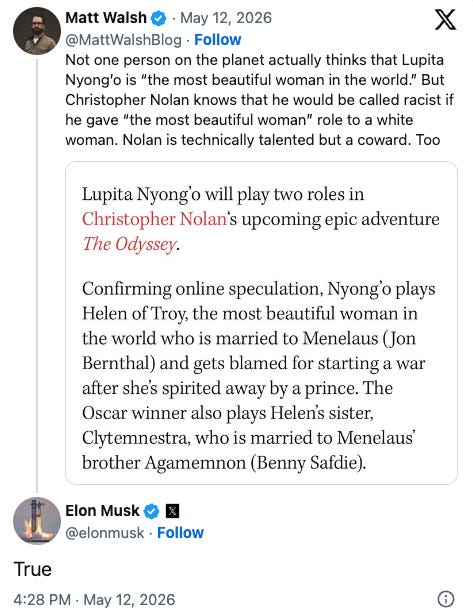
When the film came out to rave reviews, right-wingers kept lobbing attacks (“it will bomb,” “audience reviews are fake”), but Nolan’s “The Odyssey” kept shooting up the charts. (Full disclosure: I saw it and thought it was great. I plan to go back and see it again with my son next month.)
And then the right-wingers found themselves an unlikely ally: Emily Wilson, the translator of a 2017 version of the “Odyssey,” a version that had previously been attacked by right-wingers as “bad” and “woke.”
Here’s right-wing Twitter personality Polimath discussing Wilson’s translation on his Substack:
Emily Wilson’s Odyssey is being used as an “academic” translation, which means it is intended to be read in classrooms. It is, first and foremost, a bad translation. It misrepresents the core text, adds things that aren’t in the text, removes things that are in the text, and makes basic translation errors such as incorrectly translating “five hundred” as “fifty” and adding characters to the poem who do not exist in the text.
But that was before Wilson wrote a review that brutally ripped into Nolan’s film. Suddenly, right-wingers were pull-quoting her words like crazy, praising the progressive academic that they’d previously condemned.

Matt Walsh and Emily Wilson, allies! I did not see that coming!
And I don’t agree with either! Walsh I generally ignore, but Wilson brings some serious credentials (she translated Homer, c’mon!), and so I’ll take her piece in the London Review of Books seriously and highlight the places she’s gone as adrift as Odysseus on his raft.
Wilson begins with a few insulting ‘compliments.’ This “action movie version of Homer” is “an entertaining way to hide from the high temperatures for a few hours.” Ouch. And, “my teenagers had a good time” backhandedly dismisses both the film and her kids! It’s “an elaborate Fourth of July fireworks display – and with about the same level of narrative and emotional depth.” Another ouch.
This is followed by many paragraphs of gratuitous insults (“The Odyssey features his usual combination of grandiosity and superficiality,” “there is no restraint in Nolan’s version,” “Nolan gives us an all-inclusive buffet”) before Wilson gets to any substantive criticism.
Getting on to specifics, Wilson starts by having problems with Nolan’s race-neutral casting, but not because it’s race-neutral (the right-wing’s reason for not liking it), but because, she claims, it tokenizes the non-white actors.
Most of the non-white actors – Zendaya, Lupita Nyong’o, Himesh Patel, Corey Antonio Hawkins, Travis Scott – play versions of the Black best friend, whose only role in the drama is to provide aid to the white protagonist.
This is laughably wrong. What a way to demean actors doing their jobs with talent and panache. And can Himesh Patel, a British Indian actor, be a “Black best friend”? More importantly, Wilson’s label is just plain inaccurate! Zendaya’s ever-present Athena/Priestess of Athena is a constant reproach to Odysseus’s crimes. She’s not giving him aid; she’s making him feel shame for the horrors he let loose on Troy. And Patel, playing Eurylochus, essentially stages an escalating mutiny against Odysseus. Eurylochus makes it clear that he and the men have lost faith in Odysseus. He then insists that the men go in search of food without their leader (which turns out badly when they meet Circe), and later Eurylochus gives in and eats Helios’s cattle, condemning all the sailors but Odysseus to death. This is not the behavior of a trusty yes-man!
And how exactly is Lupita Nyong’o’s bitter and face-scarred Helen providing aid to Odysseus? Rather than offer support, she sneers at her cuckolded husband and tells Telemachus to apologize to his mother for all the battles fought in her (Helen’s) name. Nyong’o’s Helen undercuts the whole myth of brave male glory.
Throughout her essay, Wilson says there is nothing wrong with changing or leaving out parts of Homer’s poem, and then in the next breath condemns Nolan for changing or leaving out some part of the poem. For example, she says it “may have been sensible to leave [the gods] out,” but then goes on to complain that he mostly left the gods out! And when goddesses do appear, “there is no sign that we are supposed to realise they are goddesses.”
Nolan’s vision of the world is not quite big enough to include either real gods or real people who might be different from us.
But he doesn’t leave them out! Who punishes the crew after they blind Cyclops? Who kills Odysseus’s men for eating the sacred cows? The gods are not portrayed as glowing CGI figures, but they are very much present. The film creates a world of mystery and magic. That Wilson does not see this is to her discredit, not Nolan’s.
Wilson is also upset that Nolan dropped the Island of Scheria and Penelope’s dreams. It’s unsaid but pretty obvious that what Wilson wants is a 30-part miniseries (although not directed by Nolan, whom she’s sure would wreck it). She reminds me of all the Tolkien nerds who were upset that Peter Jackson left out Tom Bombadil and the Scouring of the Shire. People too attached to the text forget that movies, even three-hour movies, cannot cover the same ground as 1,000-page epics.
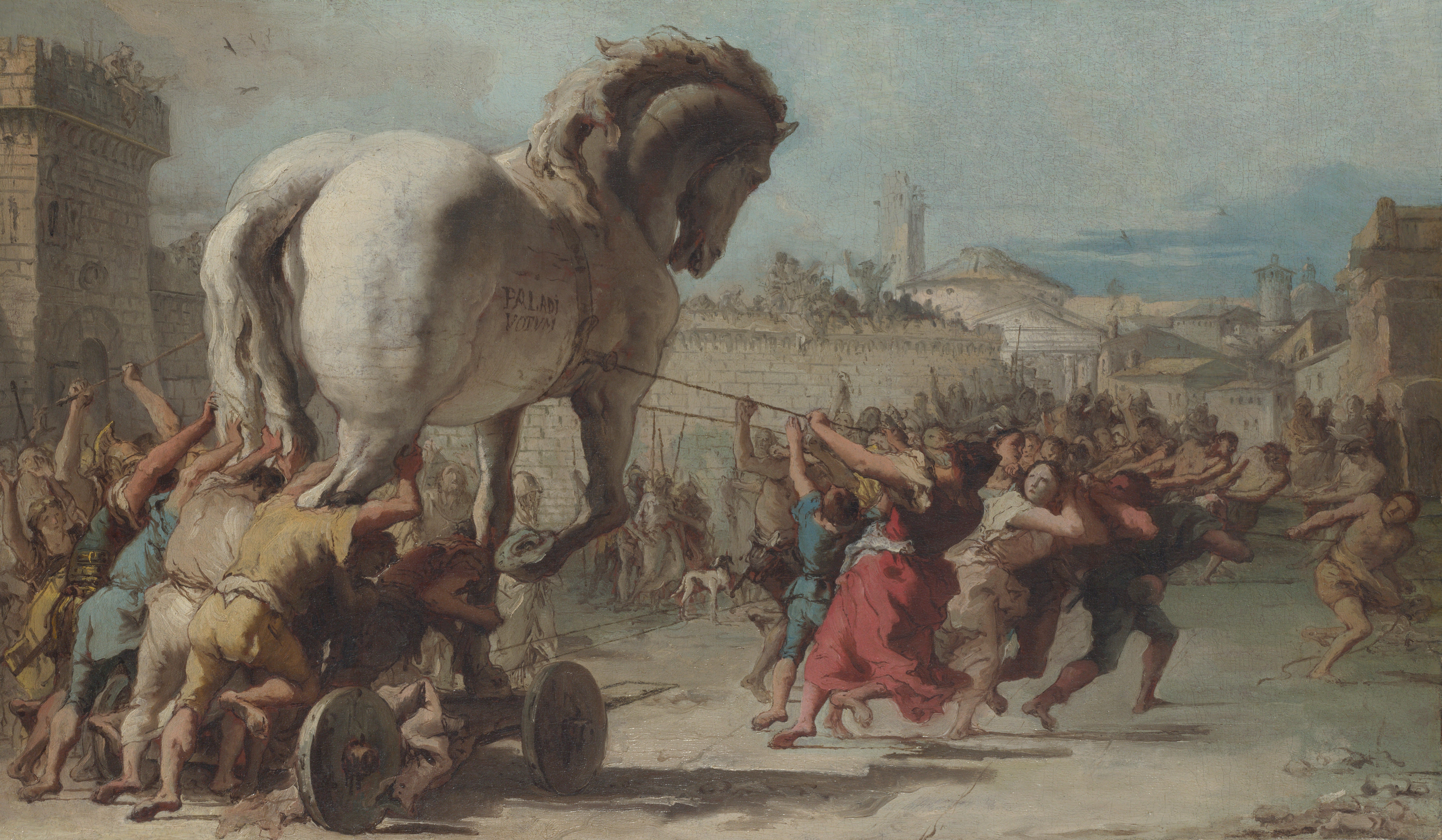
Wilson is also bothered by Nolan’s choice not to show Odysseus as an engineer, crafting his raft or building his marriage bed. Even the (very cool) Trojan Horse draws her ire.
We don’t see the design or construction of the Trojan Horse; instead, a kitsch, poorly designed horse (with no wheels) appears on the windswept beach as if dumped there by drone. The difficulties of transporting large, unwieldy objects over difficult terrain must have been on the director’s mind as he lugged his IMAX cameras through the film’s many challenging locations.
She wanted wheels on the horse? In Homer’s poem, no wheels are mentioned. Wheels only come in some later depictions (such as Virgil’s Aeneid). As for the difficulty of transporting the horse, Nolan explicitly illustrates it when we watch the Trojans expend much sweat carrying the horse across the sand.
Unlike Wilson, I thought Nolan’s Trojan horse was amazing, far more plausible than all those wheeled images I’ve seen in cheesy illustrations. And the scene where they hide in silence amid the rising waters and their own filth does much to capture the horror and brutality of war.
Next, Wilson, by implication, criticizes Nolan for using a “debunked” theory.
Nolan’s other major addition to Homer’s narrative is the repeated reference to threats to ‘our civilisation’ from ‘the sea peoples’ – a now debunked 19th-century theory about maritime tribes who were thought to have attacked Egypt around 1200 BCE and to have also been responsible for the roughly coeval collapse of Mycenaean Greek culture.
It’s true that the old story of a united tribe of Sea Peoples helped to bring down civilization has been discarded, but the reality of any seaborne raiders has not been “debunked.” Modern historians agree that that time was characterized by war and piracy, which contributed to the Bronze Age Collapse.
The current consensus, as Nolan clearly knows, is that there was no such thing as ‘the sea peoples’
I’m sure Nolan does know there was no unified tribe of attackers, but his “Sea Peoples” in the script are a stand-in for the general violence and disorder that is helping to bring down Greek society. This seems well within the limits of artistic license.
Wilson also condemns what she sees as unexplained contradictions in Nolan’s “Odyssey” universe.
In Nolan’s Odyssey, slaughtering people with the help of trickery, technology and weapons is presented as bad when the Greeks are killing the Trojans, who have violated xenia, but good when Odysseus is killing the suitors, who have violated xenia. Taking something ostensibly abandoned by Odysseus and his comrades is natural and forgivable when the Trojans lay claim to the horse, but unnatural and unforgivable when the suitors lay claim to Odysseus’ palace, food, wine and wife. Strangers in Ithaca are to be treated with gracious kindness, as possible gods in disguise; but strangers in foreign lands are usually monstrous, to be blinded, robbed and slaughtered.
There are answers to these contradictions—the slaughter of the Trojans is an unjustified violation of the ancient rules as well as disrespect to the gods, while the slaughter of the suitors is justified by the suitors’ own bad behavior and grave violation of xenia—but Wilson is allowed to have her opinions, and each viewer will see these scenes through different interpretive lenses. Even though I don’t agree, I don’t think she’s unfair to make these points. It is the strongest part of her review.
Even so, this line left me incredulous.
Nolan’s Odyssey lacks many of the elements that make the poem great. It has nothing convincing to say about time, memory, history, war, or about the relationship between one warrior’s glorious return and the lives of his family, adversaries, comrades, friends and neighbours.
What film was Wilson watching? Perhaps the central theme of Nolan’s “The Odyssey” focuses on the nightmare of war and how it haunts even the dead (Sinon). I still shiver thinking about the soldiers hiding in the Trojan Horse, keeping silent despite their filthy, desperate conditions. The sack of Troy shows war as collective madness and destruction. The doomed priestess of Athena stares in accusation at Matt Damon’s guilt-ridden Odysseus. And throughout the film, Damon portrays Odysseus as a man suffering greatly from all he’s seen and done. Nolan’s “The Odyssey” also makes it clear how much family and community suffer because of their men’s absence.
Even Odysseus’s homecoming brings out more of war’s brutality. Yes, we cheer when slimy suitors get skewered, but there is nothing glorious in the scene. Death is always ugly.
But at least Wilson gave me a laugh here.
There are no sex scenes, and all the food looks horrible.
Poor Emily Wilson! Of course, there are no actual sex scenes in Homer’s “Odyssey” either. Sex is clearly happening, but it’s more of the “he went to her bed,” and then Homer’s poetic camera cuts away. Still, it’s very clear that Odysseus and Circe hook up, and Odysseus and Calypso are lovers for seven years. The first relationship is ignored in the film; the second is clear, but not emphasized. I don’t mind the lack of sex—again, this is not that 30-part series where you can pack everything in—but Wilson is allowed to regret its absence. A different film might have chosen to explore that side of the Odysseus story.
The food line is just weird. What food was Nolan supposed to have made look tasty? The slop Circe fed to the sailors? Or whatever the suitors were always chowing down upon in Odysseus’s home? Was Wilson hoping for something like Le Bernardin’s lunchtime saumon avec sauce vin jaune?
Wilson's final zinger is perhaps the most unfair.
The most troubling ethical problem with Nolan’s Odyssey concerns the decision to film part of the movie in the occupied territory of Western Sahara, thus normalising the ongoing violence against the indigenous Sahrawi people.
Wilson provides no evidence that Nolan’s film in any way harmed the Sahrawi people. Are films only supposed to shoot footage in completely unproblematic places? Saying that Nolan is complicit in “normalising the ongoing violence” is gross.
I would be ashamed to have written any part of this script.
This mean-spirited line, found midway through her review, speaks volumes. In the end, Wilson the academic adores the text she so lovingly translated. This is understandable, but it leads her to undervalue that film is far more than words on a page. A director uses images, sound, actors’ expressions and behavior, music, editing, and much more to tell the story they want told. The words themselves are only part of the equation. Overly poetic words may actually distract from the message a filmmaker is trying to convey. Wilson, professionally attached to Homer’s poetry, seems unable to fully admit this truth. A film is not a poem. On some level, Wilson clearly knows this—she praises some of Nolan’s imagery—but in the end she still primarily judges the film as a betrayal of the text, and that is a mistake.
> Nolan’s Odyssey lacks many of the elements that make the poem great. It has nothing convincing to say about time, memory, history, war...
Lol, while you're at it, might as well argue "Titanic has nothing convincing to say about the unsinkability of boats."
Really enjoyed your article. I can’t help feeling that Wilson is so close to the material that she’s missing the point. As a poem, the Odyssey submerges you in an ancient world that in some ways anticipates our own but which is palpably alien. Gods walk the Earth, fate is binding, and heroes don’t need to be admirable to be honored. “Wily Odysseus” is celebrated for his trickery, falsehood, and dishonesty — and readers know that he should be admired because he is best beloved by wise Athena.
But the film is about taking the bones of the story and making it meaningful to an audience that doesn’t believe in workaday divine intervention or in prophecy, and that knows better (maybe?) than to admire cunning without mercy. If Nolan had been completely faithful, the movie would have been offputting, maybe cheesy, maybe infuriating.
Of course, anybody is free to dislike the movie for any reason they want, including Wilson. But it’s worth pointing out that it seems to be inspiring thousands of people to read the poem. And if they end up preferring it to the movie, good for them.